When music is who you are
⭐⭐⭐⭐⭐
"A love letter to music"

Guest post by Jill Timmons, DMA
These days, Creativity is trending as the new fashionable buzzword and answer to the many challenges that we face in midlife. Be creative and you will find happiness! It has even become a kind of “rebranding” tool for product marketing: our school, our company, our products are grounded in a commitment to Creativity. It leaves one wondering what they are talking about.
Creativity, however, is the unique imprint of our humanity. And from this personal expression of our very essence, we can discover most powerfully at midlife a way to recast and renew our potent purpose and meaning in life.
By midlife, most of us have had our share of disappointments, losses, or abysmal calamities, engendering a kind of liminal space—betwixt and between. Moreover, in meeting the challenge of this turbulent time, we may discover that metrics from an earlier period no longer serve us. We can be thrust into an ardent search for new meaning and purpose. It is through the discovery and application of our innate creative nature that we can recast our life journey.
As musicians know, one’s mode of creative expression is a deeply subjective choice, and one that can morph over time. There are, however, principles and processes that are embedded in most any given art form. For example, I launch a creative act with first experiencing desire, noticing what I am drawn to, and where my curiosity lies. Something within me creates a spark of attention. There is energy, illumination, and clarity as to what attracts me. I want to explore, develop, form, craft, or generate something new. I feel a certain intensity or passion in following this engagement. Consequently, I discover a rightness to what I am doing. I cannot not do it. As a musician, for example, I encounter moments of grace and ecstasy that may be in tandem with frustration, doubt, or discouragement. Preparing for a performance requires long hours of study and rehearsal. Then in that temporal moment of live performance, I must be fully present to my rigorous preparation. In wrestling with this creative process, I discover, nevertheless, that there can be flow to what I am doing. Even though the way can often be uncertain, I bear a deep awareness of inevitability as the course of events unfolds. These are the markers of an authentic integral creative act.
You might ask, how does this matter? It matters because Creativity requires an intrinsic perseverance, faith in the eventual outcome however it manifests, and tensile strength to sculpt and sustain an artistic vision and plan over an indeterminant period. Aren’t these the essential qualities for artfully navigating midlife and into the elder years, creating a potent all-in life?
Everyone has a creative impulse. On the other hand, in our noisy distracted world it can sometimes be difficult to simply hear our own thoughts. If you are seeking a new creative vision, one that can reveal renewed meaning and purpose to your life, my recommendation is to first start by carving out a personal retreat for at least a few days. In my experience, this requires digital celibacy. Spend time in nature, notice your surroundings, and if you feel inclined, walk to nowhere. What do you notice? Write freely about this, perhaps in a journal. What would you do if you didn’t have to earn a living? In the quiet of your retreat and in answering this question, you will undoubtedly find a new creative path, something that has piqued your excitement and curiosity. From there, you can build the edifice of a strategic action plan.
As an additional thought, a few words about purpose. We often hear about the importance of purpose in life. Certainly, purpose can give focus to how we choose to live. But purpose without deeply held meaning can become stale, dry to the touch. Unchecked it can be the genesis and breeding ground for “burnout.”
For example, let’s imagine for a moment the following scenario. For many years, as a pianist I taught and performed as a university professor and resident artist. That savoury work became my professional purpose. Nevertheless, I discovered that the meaning of that purpose shifted roughly every seven years. Invariably, I longed for some fresh creative path, one where I could be newly challenged and inspired. Inevitably, the consequence of this search was an infusion of new meaning. While I have remained in the music profession, the meaning of how and why I serve continues to evolve.
Lastly, harnessing your own brand of Creativity may also extend your life. Recently, researchers from the University College of London analysed survey data from a long-term study in the United Kingdom which included some 3,500 adults who ranged from very engaged in the arts to those who chose minimal involvement. Professor Daisy Fancourt reported the research team’s findings: “We found in this study that ‘arts engagement’ was related to 4% slower ageing rates, meaning people were about a year younger, biologically, if they were regularly engaged in the arts. This is actually the same reduction in biological ageing that we saw for physical activity,” she says. These findings are published in the journal Innovation in Ageing.
At midlife and into our elder years it is through harnessing the power of our own Creativity that we discover a way forward in answering the search for new meaning, purpose, and greater authenticity. In doing so, we can also enrich the lives of those around us. Consequently, that purposeful life then becomes our legacy—a gift to the collective.
Jill Timmon’s latest book Variations on Life after 50: A Field Guide to Harnessing the Power of Creativity, Purpose, and Legacy in Midlife is available now. Find out more
Jill Timmons is a leading international arts consultant
Ahead of this year’s London Piano Festival, an interview with artistic directors Katya Apekisheva and Charles Owen
The London Piano Festival is now in its eleventh year. How has your original vision for the Festival evolved since you founded it in 2016?
KA: Our festival is in its 11th year. One of the challenges for us is making each festival varied, interesting, creating something new/unusual each year, having some surprises in store. Since starting the festival in 2016 where our main events were piano recitals, we realised that we needed a greater variety of events. We introduced masterclasses, more spoken word events. Last year one of our highlights was an event with BBC journalist Steve Rosenberg, playing his improvisations and talking about his life in Russia today. This year we are introducing foyer concerts with young upcoming pianists. We want to keep our audience interested and always try to bring fresh ideas into each festival.
When you begin planning a new Festival, what comes first: particular artists, repertoire, a theme or simply music and musicians you feel audiences should hear?
KA: It’s a combination of all these things. It usually takes us a while to come up with the programme for each year. We start with talking about artists we want to invite, and interesting events that we can create. We don’t really plan to have themes as such, although 2027 is a Beethoven anniversary year and we definitely want to include his works in our programming . This year we really liked the idea of inviting George Benjamin to talk about his studies with Messiaen. It’s a unique opportunity for the audience to hear about Messiaen as a person/teacher as well as to hear his music.
This year’s programme ranges from Mozart, Chopin and Schubert to Messiaen, George Benjamin and jazz. What connects these apparently very different strands for you?
CO: The connections are simultaneously subtle and clear. The influence of Mozart upon Schubert’s youthful style then develops into the extraordinary originality of the latter’s visionary piano sonatas. Messiaen, one of the most original and spiritual voices of the twentieth century, links to George Benjamin’s music through harmonic, textural and personal connections. Piano music without Chopin’s profound insights into the possibilities of the instrument would be unthinkable. His influence on successive generations of piano composers can be sensed in the way that jazz pianists use patterns and the resonance of the harmonic series.
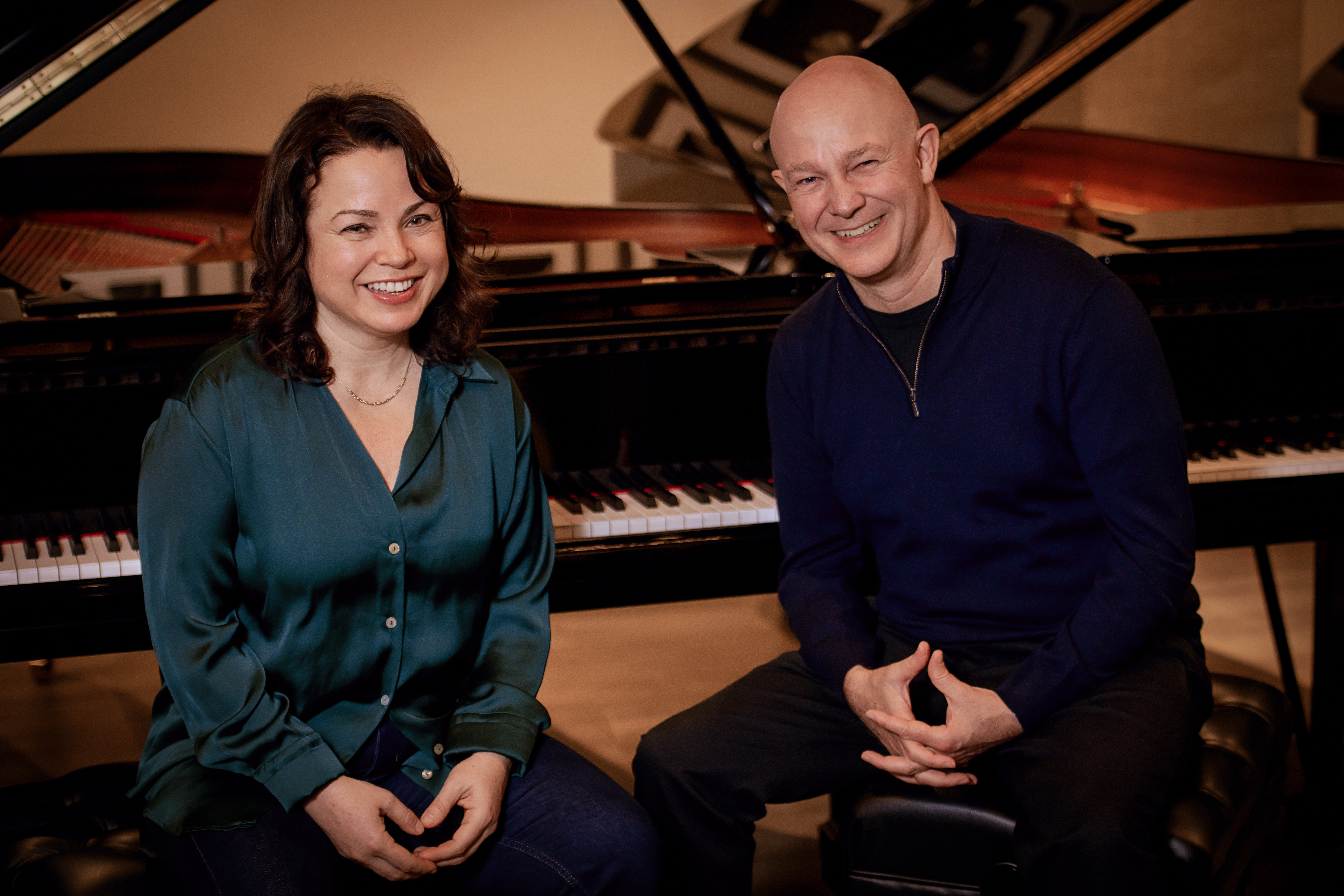
The Festival opens with Divisions & Visions, exploring the musical relationship between Olivier Messiaen and his former pupil George Benjamin. What particularly attracted you to this idea, and to placing it at the opening of the Festival?
CO: Katya and I have always admired Messiaen’s epic ‘Visions de l’Amen’, a work we were asked to learn for the 2018 Kings Place series, Time Unwrapped. This gripping two piano epic, composed during the darkest days of the Second World War, has a profound spiritual message and fantastic musical imagery. In performance the piece always has a sense of ‘occasion’ making it an ideal choice to open a piano festival.
I met George Benjamin earlier this year whilst performing in the inspirational Korean festival of Tongyeoung. Our conversation touched on his studies with Messiaen in Paris revealing fascinating insights into an extraordinary, formative time. To then discover that he had recently written a new piece entitled ‘Divisions’ was too much of a coincidence. The ideal companion piece for Messiaen.
Collaboration has always been an important feature of the London Piano Festival. What is it about playing with another pianist – whether four hands or at two pianos – that you find especially rewarding?
KA: Playing with other pianists is a very rewarding and interesting experience. Pianists don’t often play together, we are solitary creatures who spend a lot of time alone with a piano. I personally find learning about sound and different approaches to music very interesting. I love learning from my colleagues and it couldn’t get any closer, particularly when playing 4 hands repertoire. You literally feel each other’s breathing. So even though we have different personalities we have to play as one person which is a unique challenge.
This year’s Mozart Piano Gala brings together pianists at different stages of their careers. How important is it to you that the Festival creates this kind of meeting place between generations of musicians?
CO: The aspect of collaborating across generations through performing and rehearsing together is one of the most important, indeed essential aspects of the London Piano Festival. We’ve done similar projects on both two pianos and four hands throughout the last decade with always memorable results and warm audience response.
Alongside concerts, the programme includes a masterclass and a behind-the-scenes exploration of the concert grand. How important is giving audiences access to the process of music-making, as well as the finished performance?
CO: I always enjoy discovering more about the inner workings of any subject, how a painting is restored, an exhibition curated or a garden designed. With our masterclass from renowned pianist Kathryn Stott, the audience will be able to glimpse insights into musical and pianistic preparation ahead of performance.
As for Ulrich Gerhartz’s talk on the inner workings of Steinway pianos, this will be an unmissable occasion for all who have an interest in the mechanics, beauty and sheer magic involved in preparing the finest instruments.
You have consistently included jazz alongside classical repertoire. What do you feel artists such as Bill Laurance bring to a festival centred on the piano?
KA: We both love Jazz piano and from the first festival wanted to have jazz at every festival as an essential part of it. Jazz piano recitals bring a very different audience to the festival which is great. During the last ten years we had some exceptional pianists take part- Leszek Mozdzer, Julian Joseph, Gwilym Simcock to name a few. We are really excited to have Bill Laurance return to our festival after 5 years. He is the most exciting musician and the audience loves him! His concert is nearly sold out so get your tickets fast!
After eleven festivals and more than 50 classical and jazz pianists, what have you learnt about piano audiences – and has anything particularly surprised you?
CO: What has delighted us is the amazing thirst from audiences for piano music of all kinds. Their is limitless curiosity from music lovers who wish to experience the huge variety of piano repertoire played live.
Surprises? Only the fire alarm interruption and audience evacuation during the first half of Federico Colli‘s 2019 recital. He was unfazed and went on to deliver a blazing performance of Mussorgsky!
What would you each choose as your personal “don’t miss” moment of the 2026 Festival – and why?
KA: It’s very hard to pick one as we are both passionate about all the events!
For me it would be the Benjamin/Messiaen event because you get an opportunity to get an insight into Messiaen’s personal world as well as hearing his rarely performed masterpiece Visions de L’Amen.
CO: My personal ‘don’t miss’ moment will be the talk between composer George Benjamin and Donald McLeod, the voice of BBC Radio 3 ‘Composer of the Week’. A rare opportunity to encounter one of the world’s leading composers sharing his insights into a wide range of musical worlds.
The 2026 London Piano Festival at Kings Place runs from 29 October to 1 November. Find out more
(Image: Viktor Erik Emanuel)
Guest post by Caroline Swinburne
My novel Khrushchev’s Piano (The Book Guild, 28 November) is a re-imagining of the 1958 inaugural Tchaikovsky Competition. The real-life story of how brilliant young American pianist Van Cliburn achieved victory against the odds is well-known, but in my fictional 1960 Rubinstein Brothers’ Competition, it is glamorous British pianist Evie Mason who rises to international acclaim. However, life does not run smoothly for my talented protagonist; decades later we re-encounter Evie, now a disabled and impoverished old lady living in a failing care home and still struggling to make sense of events dating from her time in Soviet Russia.
Every chapter of my book is introduced by a different piece of piano music. Often the music is played by my characters; on a few occasions it simply reflects the mood. Much of this repertoire is Russian or Soviet, including several pieces performed at the “real” 1958 competition.
When I began writing the book back in 2017, Ukraine was little known on the world stage. Even though the country had already endured the annexation of Crimea and years of fighting in the Donbas, it rarely made the headlines in Western news reports. But Russia’s full-scale invasion in 2022 changed that overnight and I could not ignore the implications if I wanted my novel to have historical credence. As a result, I rewrote some of my contemporary storyline to reflect developments, and also changed some of the repertoire. It was through this that I first encountered the extraordinary piano music of Valentyn Sylvestrov – or, to use his preferred international form of the name, Valentin Silvestrov.
Silvestrov is one of Ukraine’s most distinguished living composers. Although sadly still little-known in the UK, he is more popular elsewhere in Europe, especially in German-speaking countries. His published work includes symphonies, pieces for chamber orchestra, chamber music and vocal music. But it is his solo piano compositions that many would consider that his most intimate voice is found, especially in his many lovely piano miniatures.
Silvestrov was born in Kyiv in 1937. This makes him the same age as my fictional protagonist, and his life spans exactly the same period as my novel – including the final decades of Stalinism, the Khrushchev “Thaw”, Ukraine’s independence in 1991 and, most recently, the Russian invasion of his homeland. But despite this dramatic political backcloth, the composer’s musical style has remained unique, independent and personal.
By the time of my fictional competition in 1960, Silvestrov was a student at the Kyiv Conservatory, where he studied composition with Borys Liatoshynsky and counterpoint with Levko Revutsky. Liatoshynsky, more than forty years his senior, had once been a pioneering Ukrainian modernist, but belonged to a generation whose artistic freedom had been severely curtailed by Soviet ideology. However, as a teacher, he encouraged younger composers including Silvestrov to pursue their own ideas.
Fortunately, this was a time when the Khrushchev “Thaw” was opening up new possibilities, and after graduating, for a while Silvestrov became closely associated with the Kyiv Avant-Garde, a loose circle of composers including Leonid Hrabovsky, Vitalii Hodziatskyi and Volodymyr Zahortsev. The group were keenly interested in Western modernism – from Webern and the Second Viennese School to the experiments emerging from Darmstadt – but also concerned to develop their own distinctive musical language within the wider artistic and intellectual life in 1960s Kyiv.
Silvestrov’s music soon began to attract international attention. German philosopher, musicologist and social theorist Theodor Adorno described him as an ‘extraordinarily gifted’ composer. In September 1968, Bruno Maderna conducted the world premiere of his third symphony, Eschatophony, at the Darmstadt Summer Courses – a principal centre of the European avant-garde. In 1967 the work was awarded the Koussevitzky Music Foundation Prize and three years later his Hymn received an honorary distinction at the Gaudeamus International Composers Competition in Utrecht.
Silvestrov was not a natural rebel; he described his relationship with Soviet institutions as a kind of gentle non‑compliance and emphasised that he simply wrote the music he felt compelled to write. From the 1970s onwards he moved away from radical modernism towards what he described as a ‘metaphorical’ style – a way of writing which absorbed echoes of the past without simply reverting to traditional tonality. This was not a response to political repression, but rather part of a deeper artistic journey – a conscious artistic decision made by a composer who had already achieved international recognition.
Kitsch-Musik, written in 1977, is one of the most important and frequently performed of his early piano works and marks his transition towards this new style. The piano cycle is published by Schott Music, whose catalogue includes many of Silvestrov’s best-known scores, although much of the composer’s later work, including many piano miniatures, have sadly never appeared in print. However, many of the unpublished works have been recorded – often by the composer himself – and are readily available in a large online archive, at https://silvestrov.bandcamp.com/
After Russia’s full-scale invasion of Ukraine in 2022, Silvestrov fled Kyiv with his daughter and granddaughter and has since lived in Berlin. Although he is aged nearly ninety and has hearing problems, he has continued to compose prolifically; for a while he continued to post regular recordings of his music in the Bandcamp archive. However, in recent years, his own performances have become less frequent, and many recent premieres and recordings have been entrusted to the Ukrainian pianist Evgeny Gromov, one of the foremost interpreters and champions of the composer’s piano music.
In my book, I feature Silvestrov’s lovely Three Bagatelles op 1. These works, written in 2005, are intimate, lyrical and accessible. Comparing the compositions to his larger works, the composer wrote: ‘My second Sonata, for example, is a concert piece, and is not designed to be played in a domestic setting. But [the piano miniatures] are pieces which one can play (or listen to) at home, even if they require a subtle use of the pedal and sophisticated timbres. These are, as it were, domestic animals such as cats, whereas the works based on a philosophical idea can be compared to tigers, which are also cats, though it is impossible to keep them as domestic animals.’ (Music Is the Song the World Sings About Itself ed. Marina Nestieva, Kyiv, 2004, Russian)
Tame, domestic cats they may be, and at first sight the notes themselves seem relatively straightforward. However, as I soon discovered when I attempted to play the pieces myself, Silvestrov’s piano music poses significant challenges if the performer is to do full justice to the composer’s vision. Minutely notated nuances of duration, dynamics, tempo and pedalling are an integral part of the compositions, and take time, attention and thorough practice to master effectively.
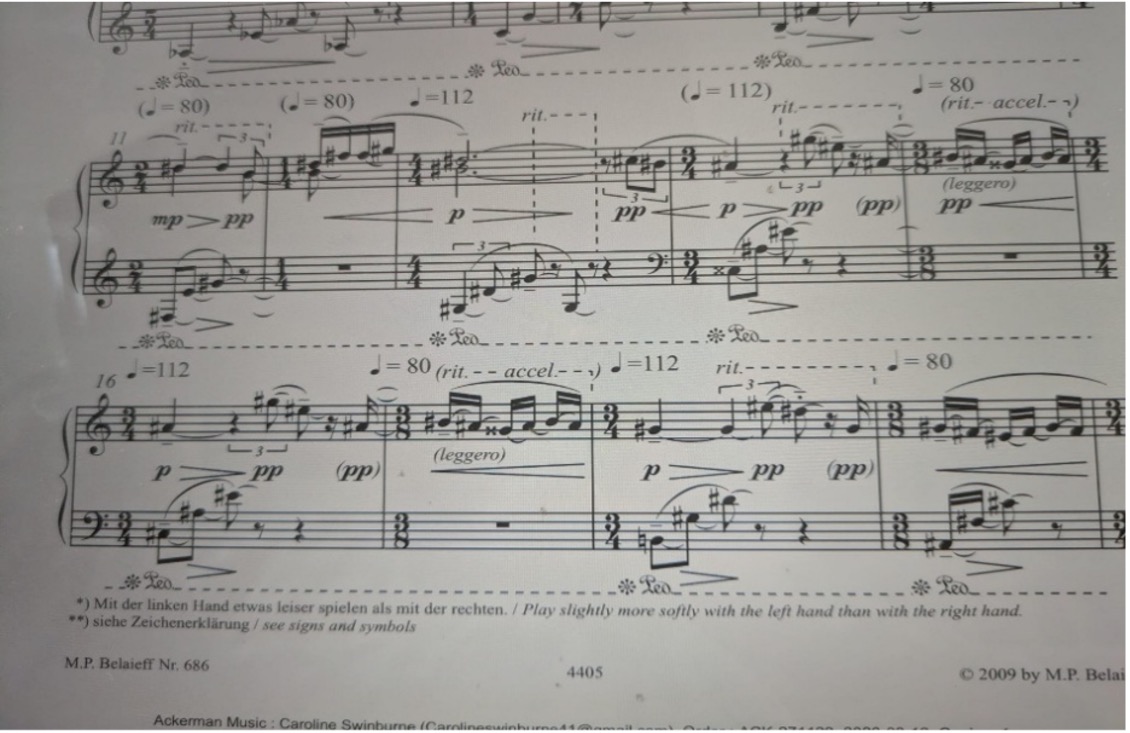
‘The expressive meaning [of Silvestrov’s music] resides less in the notes themselves than in their breathing, timing, decay and infinitesimal dynamic inflections,’ says Yar Godyna, who curates the composer’s online archive and knows the composer well. ‘This music demands an exceptional sensitivity to tone, timing, pedalling and the natural decay of sound. It also requires patience: one has to resist the temptation to “express” too much or to impose an overt personal interpretation. The music speaks quietly, and the performer has to trust that quietness.’
However, Godyna thinks that much of Silvestrov’s later piano music is technically accessible to a good amateur pianist as long as he or she is prepared to be thorough. He suggests beginning with Kitsch-Music or the published Bagatelles, which are accessible and provide an excellent introduction to the composer’s musical language. ‘Above all, I would advise [the would-be performer] to listen carefully to Sylvestrov’s own performances on the bootcamp archive. He rarely treats the score mechanically; despite the extraordinary detail of his notation, his playing sounds remarkably free, almost improvised. That apparent paradox is perhaps the most important lesson for anyone approaching his music.’
Drawing parallels with the writing of Erik Satie, Godyna considers that Silvestrov’s piano works: ‘reward maturity more than virtuosity. A pianist with a beautiful touch, a sense of silence and the ability to sustain long musical lines will often be more convincing than a brilliant virtuoso who approaches the music as a display of technique. [Silvestrov’s piano miniatures] demand an exceptional sensitivity to tone, timing, pedalling and the natural decay of sound. [They] also require patience: one has to resist the temptation to “express” too much or to impose an overt personal interpretation. The music speaks quietly, and the performer has to trust that quietness.’
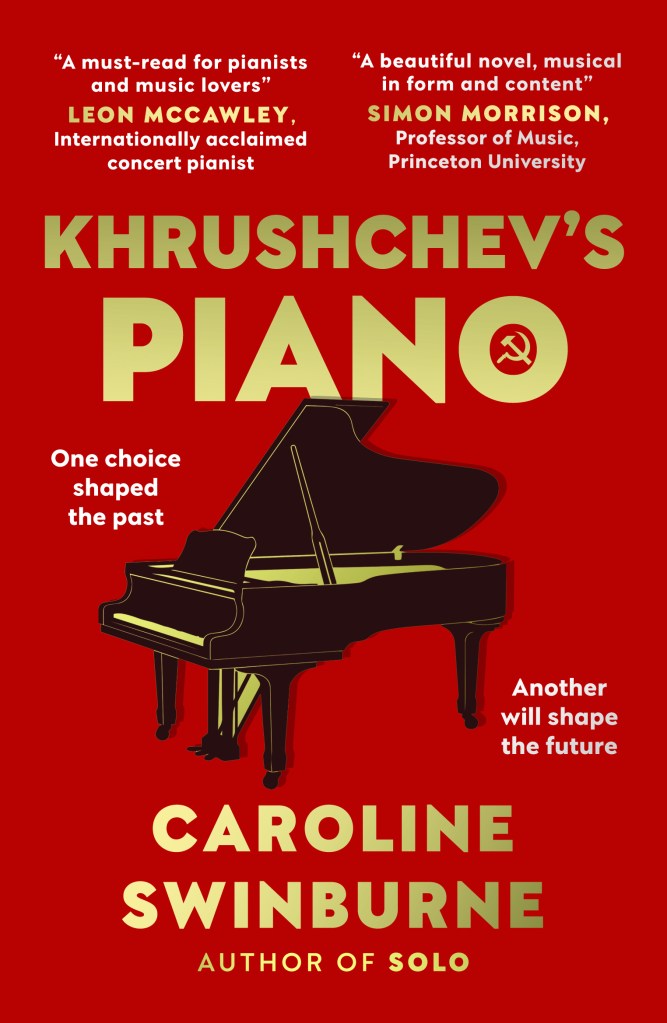 Khrushchev’s Piano will be published by The Book Guild on 28 November
Pianist Konstantin Lapshin will be performing a recital of music from Khrushchev’s Piano, including some works by Valentin Silvestrov, at the 1901 Arts Club on Friday 5th March 2027
Useful resources
If you enjoy this site, you might like to visit my new Substack page where, writing under my own name, I share more personal musings on music, creativity, artistic identity, memory, Dorset, food, gardening – and whatever else catches my interest. Click the image below to visit my Substack.




